
01.09.26 — 04.10.26
POST-TRADITION I: LAYERED THRESHOLDS
A group exhibition by
Download E-Catalogue
The Post-Tradition Tetralogy in Indonesian Contemporary Art
Jakarta: Modernity, Displacement, and the Threshold Condition
The Post-Tradition Tetralogy which began in Jakarta embarks from a paradox. Among the cities where
this series is presented, Jakarta may be the city in which the presence of tradition is most
difficult to be recognized daily. This does not mean that tradition in other parts of Indonesia has
not undergone change. Modernity has reached almost every part of Indonesia and transformed, with
varying intensities, people's relationships with custom, environment, material, ritual, community,
and various forms of inherited knowledge. In Jakarta, however, these changes unfold with a far
stronger metropolitan intensity.
As a center of the economy, government, commerce, education, media, and myriad opportunities,
Jakarta has long attracted people from across Indonesia. Urbanization, development, capital,
technology, and flows of information have caused the city to grow not only through its physical
construction, but also through the arrival of those seeking employment, education, social mobility,
and possibilities for a better life. Modernity is concretely present in everyday life: it enables
mobility and encounters, while simultaneously presents inequality, ecological pressure, spatial
homogenization, consumerism, and intensifying logic of capitalism. Jakarta is not merely a modern
city; it is a city that is continuously becoming modern, without ever fully resolving its
relationship with the various worlds that preceded it.
This paradox is visible in the question of tradition. Betawi culture, most associated with Jakarta's
identity, continues to face transformations amidst metropolitan space and life. The villages,
patterns of social relations, and the environments that sustain them are changing along with the
city's development. Tradition does not simply disappear, but the social ecology that sustains it is
continually shifting.
At the same time, Jakarta has never been a city with a single cultural origin. People from Java,
Sunda, Minangkabau, Batak, Bugis, Bali, Madura, Chinese communities, and many other backgrounds have
arrived, lived alongside one another, influenced one another, and shaped urban life. Betawi culture
itself grew through a long history of encounters among different groups. Jakarta is therefore less
accurately imagined as a melting pot, as though everything ultimately assimilates into a homogeneous
culture. The city more closely resembles a space for cultural sedimentation: experiences, languages,
habits, values, memories, and sensibilities from different places settle as layers of life. Some
merge, some persist, some are interrupted, while others reappear in new configurations.
This sedimentation also occurs across generations. Many migrants settle, build families, and give
births to generations who grow up as Jakarta residents. The relationship with a place of origin
that, for the first generation, is still lived through language, custom, culinary, ritual, and
kinship may, in subsequent generations, transformed into family stories, particular habits, markers
of identity, or simply traces.
Therefore, the distance from tradition does not only occurs geographically but also generationally.
Yet distance does not always mean loss. The tradition that’s previously being lived through
submissively may become apparent after one gain distance from it. Tradition can be chosen,
interpreted, rejected, rediscovered, or continue to operate unconsciously through the body,
language, habits, tastes, and various forms of sensitivity. Aside from the people, the shift is also
occurring to the memories, knowledge, skills, values, and sensibilities—and all these changes came
through urban life, education, technology, social interaction, and modern experience.
From this process emerges what the tetralogy calls the threshold condition. The threshold is not a
clear line between tradition and modernity, nor a temporary state that must be resolved by choosing
one over the other. It is a condition in which a person no longer lives entirely within the cultural
environment that shaped their earlier experience yet never becomes completely detached from it. The
modernity they enter is not a single, completed system either: it offers freedom, mobility,
knowledge, and technology, while simultaneously bringing acceleration, fragmentation, competition,
and the various contradictions of contemporary life.
In Jakarta, the threshold condition does not even exist only between two poles. A person may live
simultaneously within family inheritance, urban life, modern education, popular culture, digital
technology, global networks, and various cross-cultural encounters. These layers may support or
conflict one another or even settle into something whose origins become increasingly unrecognizable.
The threshold, therefore, is a layered condition. It is precisely this incompleteness that makes
Jakarta relevant as the starting point of the Post-Tradition Tetralogy.
None of the artists in this exhibition originates in Jakarta. They grew up in different cultural
environments and were subsequently reshaped by education, displacement, modern life, and the field
of contemporary art. They appear neither as representatives of Jakarta nor as official
representatives of the cultures of their respective places of origin. For a time, they and their
works come together in Jakarta. On a small scale, the exhibition repeats something that has long
occurred in the city: different experiences, memories, and sensibilities arrive in a shared space of
encounter.
The absence of artists originating from Jakarta is not intended to suggest that post-traditional
experience does not exist within the city's artistic practices. This exhibition is not organized as
a geographical representation of Jakarta. Instead, the city is positioned as a space of encounter,
where different experiences formed in different regions and cultural environments are temporarily
brought together. The artists were selected not as representatives of their places of origin, but
because their practices reveal different distances from, and forms of transformation of, what has
been inherited—from traces still recognizable in visual language and artistry to what has settled as
materiality, metaphor, memory, or sensibility. Jakarta, therefore, is not the primary object
represented by the exhibition, but a point of view from which to read how diverse local experiences
transform when confronted with modernity and contemporary artistic practice.
Yet what the artists bring is not their authentic experience in its initial state. Everything has
undergone processes of distancing and transformation throughout their journey of becoming both
individuals and artists. Thus, the discussion of post-tradition does not begin by searching for
which forms of tradition have survived. The question is: what happens to something inherited when
people move, gain distance from their original environment, and live within modernity? Does
displacement only produce rupture? Or will it allow what has been inherited to be read, felt,
questioned, and transformed anew?
These questions move the discussion from Jakarta as a socio-cultural condition toward the principal
territory of this exhibition: the contemporary art and its practice. For artists, origins, memories,
displacement, education, and modern experience do not necessarily end as statements of identity. All
of these may settle into sensibility and undergo artistic transformation—acquiring new existence as
form, material, medium, technique, space, and aesthetic experience.
Contemporary Art: Sensibility and Artistic Transformation
If the post-traditional condition—displacement, a sense of distance from one’s origins, and
negotiation between inheritance and modernity—is experienced by so many Indonesians, the question
becomes: why is contemporary art important for discussing it? What can art do differently from
history, anthropology, sociology, or other forms of knowledge that can explain cultural change more
systematically?
Art is certainly not the most effective medium for explaining the problem of tradition and modernity
or for delivering a message directly. Its strength lies elsewhere. Art does not primarily explain a
condition but allows past experiences to acquire new forms that can be seen, felt, and experienced
again. This distinction is important because the post-traditional condition concerns not only what a
person knows about their cultural origins. It also operates through the body, memory, habits,
affection, skills, relationships with material and space, and experiences that cannot always be
immediately translated into concepts.
This is where sensibility becomes important. Sensibility is a quality of receptivity that enables a
person to experience the world through perception, the body, affection, intuition, imagination,
material, space, and rhythm, while also process those experiences into knowledge and new
possibilities. Sensibility is not the opposite of reason; it also underlies the capacity to
recognize differences, build relationships, imagine the unimaginable, and innovate.
In traditional life, sensibility is formed through an experiential ecology: relationships with
nature, material, ritual, language, mythology, skills, communal life, and various conventions
practiced over long periods. Conventions may limit individual freedom, but repetition within them
simultaneously refines perception, skill, and bodily sensitivity. Knowledge, therefore, is not
stored merely as a concept, but settles into how people do, feel, and treat things.
Modernity transforms this ecology. Education, urbanization, technology, media, and mobility open up
new possibilities for freedom and new experiences, while simultaneously altering human relationships
with the body, material, environment, community, and time. Inherited sensibilities do not simply
disappear; they may shift, fragment, and transform, while modern life forms new sensibilities toward
technology, images, individuality, abstraction, and the complexity of the contemporary world.
Post-tradition is therefore not an encounter between two pure worlds—tradition on one side and
modernity on the other. What takes place is an encounter among different layers of sensibility: some
inherited, some learned, some abandoned, some rediscovered, and others born from new experiences. If
Jakarta is a space of cultural sedimentation, at the individual level this process can be understood
as the sedimentation of sensibility.
Yet such a condition is experienced by many people. In art, the issue becomes more specific because
these experiences and sensibilities are worked through and transformed by artistic practice.
Artistic transformation is the key term here. Experience does not have to become a story about
origins; memory does not have to become a symbol; tradition does not have to appear as a motif. What
settles into sensibility can be transformed through medium, material, technique, formal decisions,
experimentation, failure, chance, and reflection during the creative process. Therefore, the
relationship between an artist's cultural background and their work is never a simple
cause-and-effect relationship. Ethnic origin does not determine artistic language; it is merely one
layer of experience that may contribute to shape an artist's sensibility.
These layers of experience become artistically relevant when transformed into decisions concerning
form, material, medium, technique, space, and process. The richness of tradition, an interesting
origin, or the importance of a social issue does not by itself produce a strong work. An artwork
gains artistic urgency when such transformation produces a form with intensity and personal
character.
For this reason, the works in this exhibition first acquire their importance as works of art, rather
than as illustrations of post-tradition. Before being interpreted, the works present themselves
through color, scale, surface, material, rhythm, form, and space. Here, the sensuous becomes
important: something can be felt before it is fully understood. This perceptual experience activates
sensibility and may develop toward imagination, memory, questions, and reflection.
Aesthetic experience and reflection therefore do not need to be opposed. What must be avoided is a
situation in which meaning precedes the work, reducing the work to an illustration of an idea. In
this exhibition, the movement is intended to occur in the opposite direction: the work creates an
experience, the experience activates sensibility, and from sensibility the possibility of reflection
opens.
This is where contemporary art becomes relevant to the post-traditional condition. Not because it
provides illustrations of tradition, but because artistic practice allows various sediments of
experience to meet and undergo transformation without having to be returned to their original
identities. Such encounters may produce tension, deviation, rupture, or new artistic languages.
Post-tradition, therefore, is important to art not as a theme that must be represented, but as a
threshold condition in which new aesthetic possibilities can emerge. The question is no longer
simply: where is tradition visible in the work? Rather: how have the various experiences that shape
an artist's sensibility been transformed until they acquire their own artistic form?
Artists in the Threshold Condition: Genealogy, Displacement, and Personal Language
The ten artists in this exhibition come from different geographical and cultural backgrounds. Some
grew up relatively close to their original traditional environments, some experienced displacement
since their education period, while others have, for quite some time, lived and worked within
different cultural environments. Their relationships with tradition are therefore never uniform.
This exhibition does not position ethnic origin as the single key to explaining the works. An artist
from Bali does not necessarily produce work that can be explained through Balinese tradition; the
same applies to artists from Minangkabau, Banjar, Aceh, Java, or other cultural backgrounds. The
relationship between an original experience and artistic language may be quite strong, but it may
also undergo such extensive transformation that it is almost no longer visible on the surface of the
work. What is inherited does not always survive as a recognizable form. It may settle as a
sensitivity toward material, rhythm, metaphor, narrative, space, the body, or relationships among
forms. In this sense, cultural genealogy may contribute to shape an artist's sensibility without
producing explicit markers of tradition.
For this reason, the term genealogy is more useful than identity for reading these practices.
Genealogy does not assume a linear relationship between origins and the work. It allows different
layers that shape sensibility to be traced without making any one of them the sole explanation. In
Handiwirman Saputra, for example, Minangkabau metaphorical tradition may be considered one possible
genealogy of sensibility, but it has become intertwined with art education, life in Yogyakarta, art
history, artistic networks, and personal experience. Conversely, Kemalezedine shows that sensibility
toward tradition does not always originate from something inherited at birth; it can be formed
through choice, learning, and a long life within a particular cultural environment.
Displacement further complicates this process. When a person leaves their original environment to
study, work, or build a life elsewhere, what they carry is not culture in its entirety, but
experiences embedded in the body, memory, language, skills, habits, and perception. Encounters with
a new environment continually transform these. For artists, geographical displacement often
simultaneously becomes artistic displacement. Art education introduces them to modern and
contemporary art history, media, techniques, theories, and the demand to establish an individual
position. The art scenes of Yogyakarta, Bali, Bandung, Jakarta, and broader networks then add
further layers of experience.
Here lies an important difference between traditional practice and contemporary art. In many
traditional practices, the work exists within systems of values, functions, techniques, and
conventions formed communally. Contemporary artists work within a field that offers greater
individual freedom while simultaneously demanding the construction of their own artistic language.
Yet this freedom does not mean that artists begin from an empty space. Artistic individuality is
still formed through a history of experience and various encounters.
Therefore, the threshold condition in this exhibition is not a state in which artists stand midway
between “tradition” and “modernity” as opposing choices. The threshold is more like a space where
multiple layers of experience meet and continually change. For one artist, tradition may remain
strongly visible; for another, it may have become a material or metaphorical sensibility; for yet
another, the relationship may have become so distant that it can barely be traced through their
work.
These differences are precisely what matter. If all the works displayed traditional motifs, symbols,
or techniques, post-tradition could easily be reduced to the question of the continuity of tradition
in contemporary art. Yet the exhibition's question is broader: what happens to inherited experience
when it enters the subjectivity of the modern individual and is subsequently processed through
contemporary artistic practice?
For this reason, the artists in this exhibition are not positioned as examples that must prove a
theory or as representatives of their communities of origin. Their practices reveal various
possibilities of transformation: from traditions that remain visually apparent to those traceable
only as genealogical layers; from personal memory to collective history; from inherited skills to
new materials and technologies. At a certain point, it is no longer productive to determine whether
an element in a work comes from tradition or modernity. After various experiences have undergone
prolonged sedimentation, the two may form something that cannot be wholly returned to either source.
This is where the artist's personal language becomes important. It is neither individual expression
born without history nor a passive product of cultural background. Personal language is formed
through processes of choosing, absorbing, rejecting, changing, experimenting, and discovering
artistic possibilities. The reading proposed by this exhibition therefore moves in two directions:
tracing the various genealogies that may have shaped an artist's sensibility, then returning to the
work to see how all of these have transformed into forms, materials, techniques, and artistic
experiences with an existence of their own.
Thus, post-tradition is not a label for artists, but a perspective for understanding how personal
artistic language can emerge from layered and continually changing cultural experiences.
From the Threshold Condition to the Artwork
If the post-traditional condition produces layered experience, the next question is how that
experience acquires artistic form. At this point, the discussion must return to the work. Cultural
origins, displacement, memory, family history, and social experience may contribute to an artist's
sensibility, but the relationship is not always directly visible. It may appear as a symbol or
narrative, but it may also have transformed into a way of handling material, arranging forms,
treating figures, constructing space, or employing a particular technique.
For this reason, this exhibition does not use the artworks as evidence for a thesis about
post-tradition. Instead, the works become the starting point for testing the extent to which a
post-traditional perspective can expand the interpretation of the artists' practices. An interesting
cultural context does not in itself produce a strong work; it acquires artistic relevance when
transformed through form, material, medium, technique, space, and process.
Thus, the work possesses a certain autonomy from the context that surrounds it. When presented to
viewers, it must be capable of generating its own visual, material, spatial, and sensory experience.
Form, color, scale, texture, rhythm, figure, space, and material can evoke intrigue, a sense of
strangeness, tension, or curiosity before their context is known. Yet autonomy does not mean that
context becomes unimportant. Knowledge of biography, history, tradition, and displacement can open
layers of interpretation that were previously invisible. Their relationship is dialectical: the work
opens experience through its artistic force, while context expands the possibilities for reflection.
Contextual reading can then bring viewers back to the work with a different attentiveness.
Curation operates between these two movements. It is not intended to provide a final meaning or
explain every element of a work as a representation of a particular tradition, but to open
relationships through which works can be read from the perspective of the post-traditional threshold
without closing off other possibilities of interpretation. Therefore, the question posed to the
works does not stop at whether tradition remains visible within them. What matters more is how
something inherited has changed: into sensibility, skill, material, metaphor, memory, or even
something whose origins can scarcely be recognized.
This is the spectrum revealed by the works in the exhibition. Post-tradition is neither a style nor
an identity category, but a field of transformation in which something can be preserved, changed,
hybridized, rediscovered, or settled into the artist's personal language.
Thus, the reading of the works in this exhibition is not directed toward finding evidence that the
ten artists are “post-tradition artists.” What is to be observed is how various experiences and
sensibilities acquire their respective transformations through artistic practice. From here, the
reading shifts from post-tradition as an idea toward the work as a concrete experience.
The Work: The Threshold as a Space of Transformation
The works in this exhibition reveal a spectrum of different relationships with tradition. In some
artists, traces remain recognizable through visual language, mythology, technique, or
representational structures. In others, these traces have transformed so extensively that they can
only be traced through sensibility, material, memory, history, or ways of understanding knowledge.
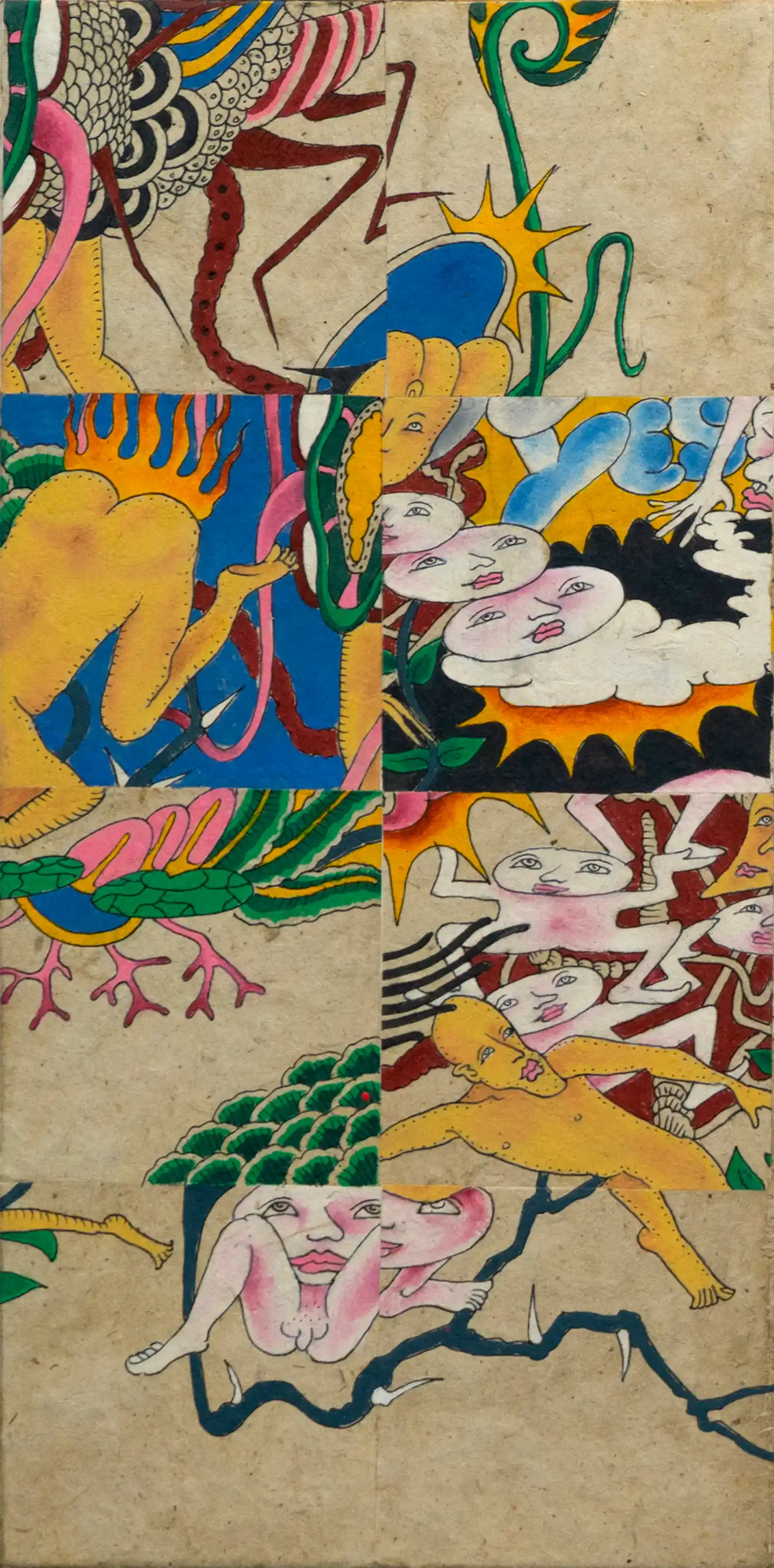
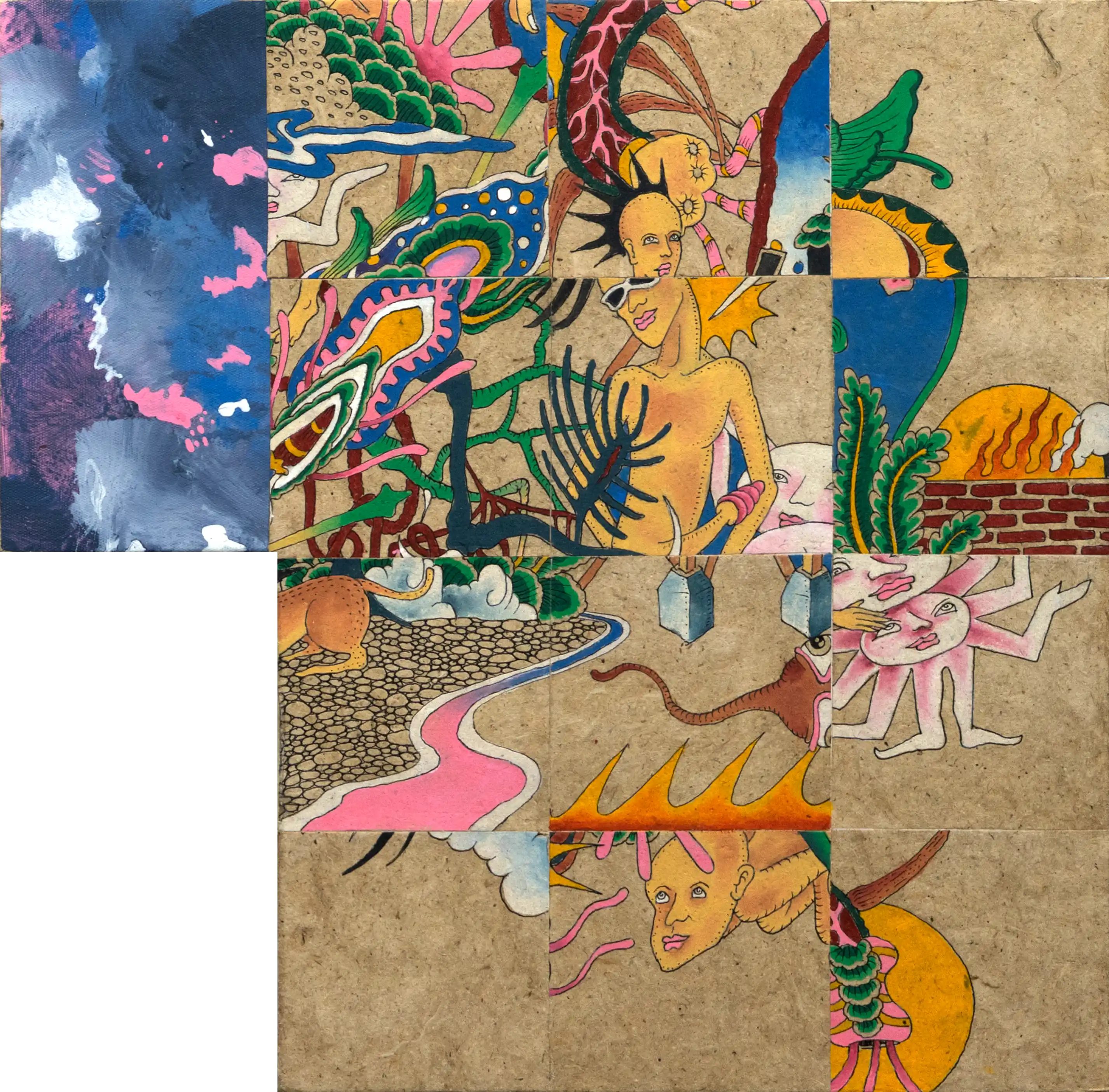
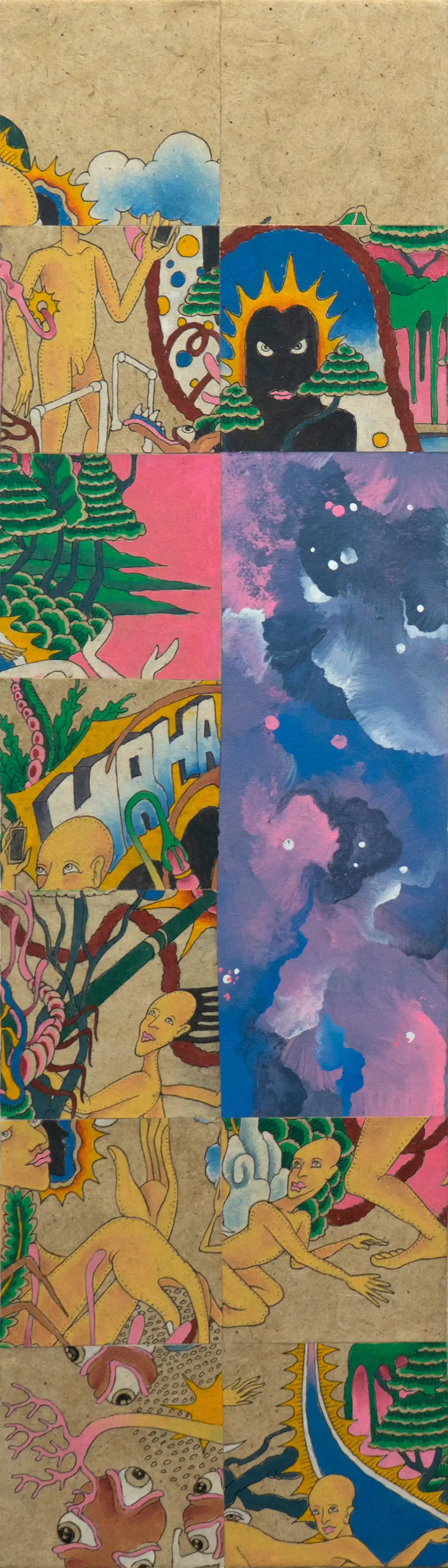
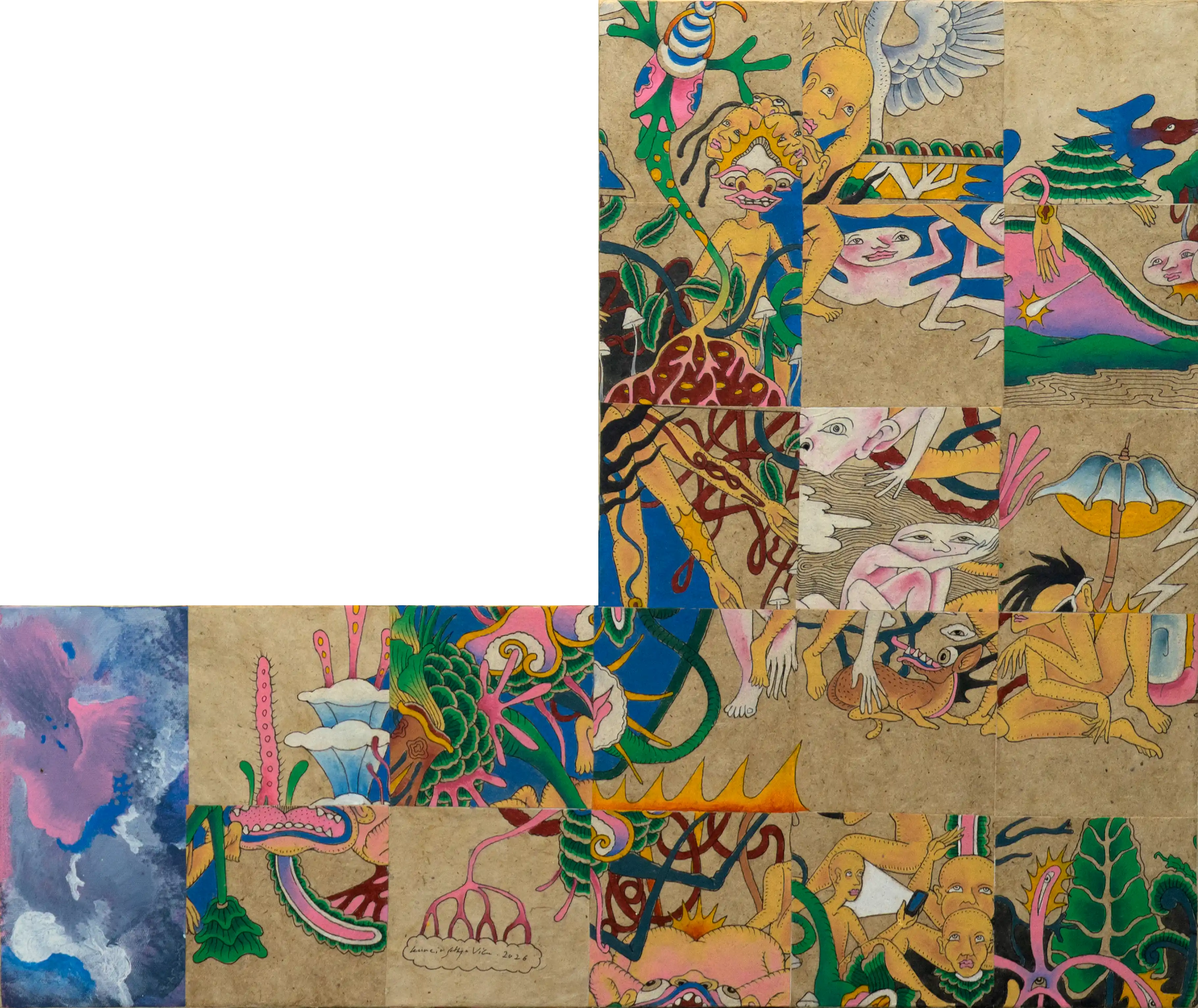
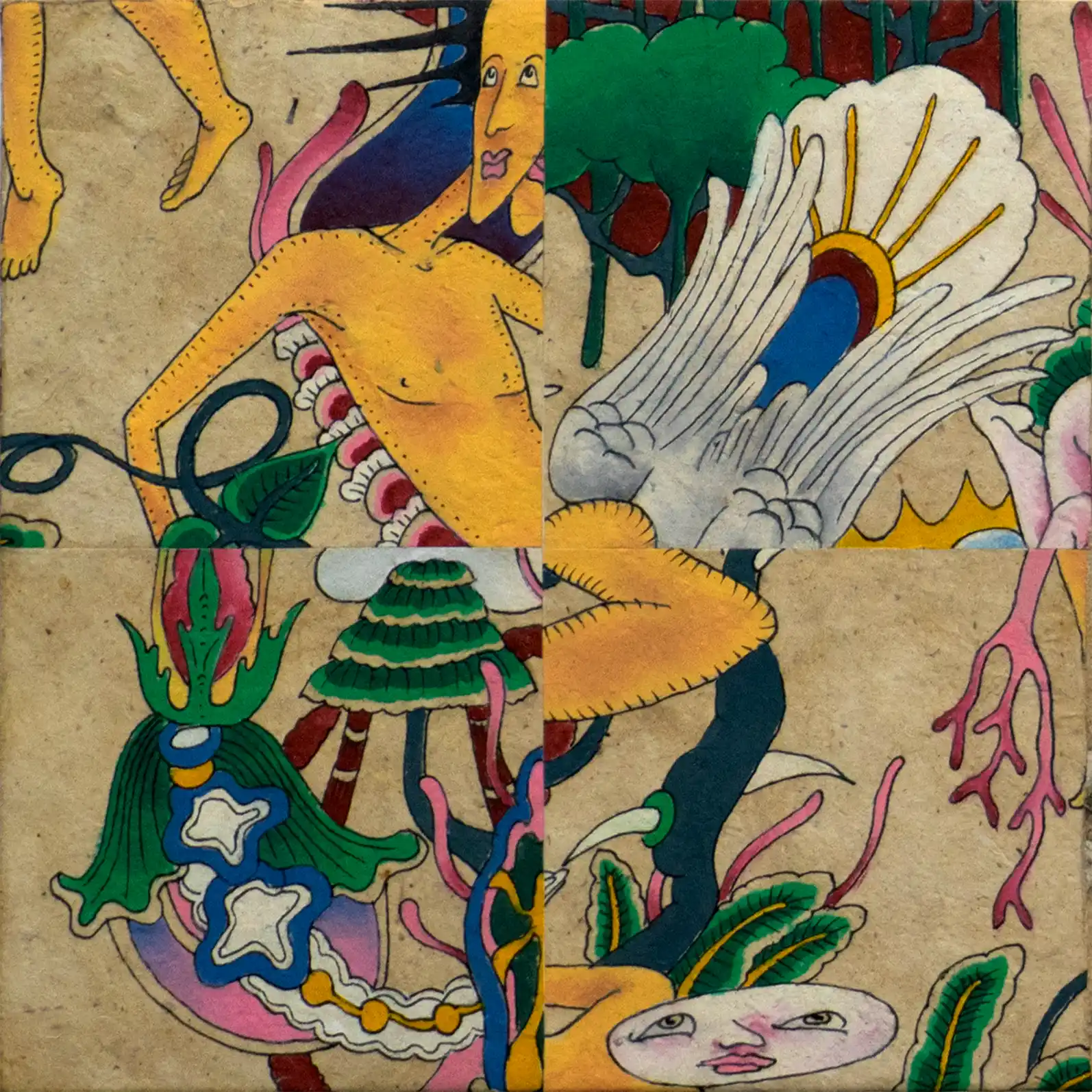
In Kuncir Satya Viku, the relationship with tradition appears relatively direct. Mythological
figures, fantastic creatures, visual density, ornamentation, and his visual tendencies still reveal
a genealogy of Balinese art and cosmology. In earlier practices, Kuncir worked with Kaliyuga,
sekala–niskala, and the myth of Lubdaka. Yet this language is not brought over as a traditional
system bound to ritual function and prescribed conventions. It enters the subjectivity of a
contemporary artist who is free to select and reinterpret it. Communal mythology is transformed into
individual imagination through rhythm, color, density, and figuration.
In Agus Saputra, the encounter occurs between Batuan painting and realism. What is interesting is
not simply the mixing of styles, but how this hybridization develops into a perspective. His figures
may appear realistic, yet the way the plane is filled, the density of visual incidents,
relationships among figures, and narrative structure continue to reveal Batuan sensibility. Two
visual genealogies have sedimented into a personal language whose sources can no longer easily be
separated.
Budi Agung Kuswara reveals another path. He was trained in Kamasan painting and retains its
complexity and delicate line quality, but his practice subsequently developed through painting,
cyanotype, archives, memory, and social practice. His use of cyanotype—a photographic process that
forms images through exposure to light—developed into an approach he calls Solar Synthetic Reality
(SSR), bringing together images mediated by archives and digital technologies, including AI, with
sunlight as a means of creating traces and the intervention of the hand through painting. The
genealogy of tradition here does not mean stylistic continuity; skills and sensibilities can persist
while artistic language moves far from its original source. In this exhibition, Budi even leaves
cyanotype behind, revealing another threshold within his own practice: between an established
language and new artistic possibilities.
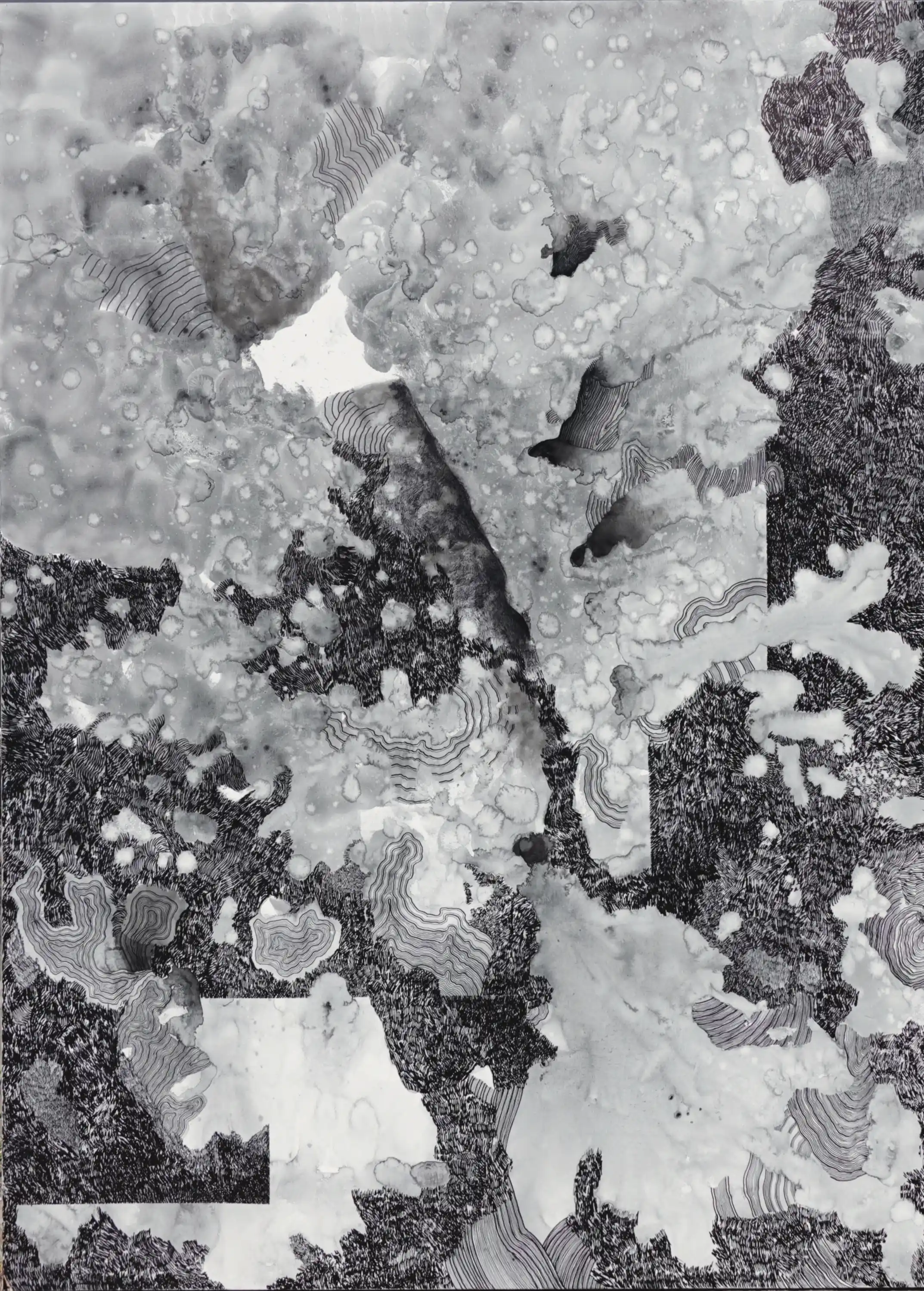
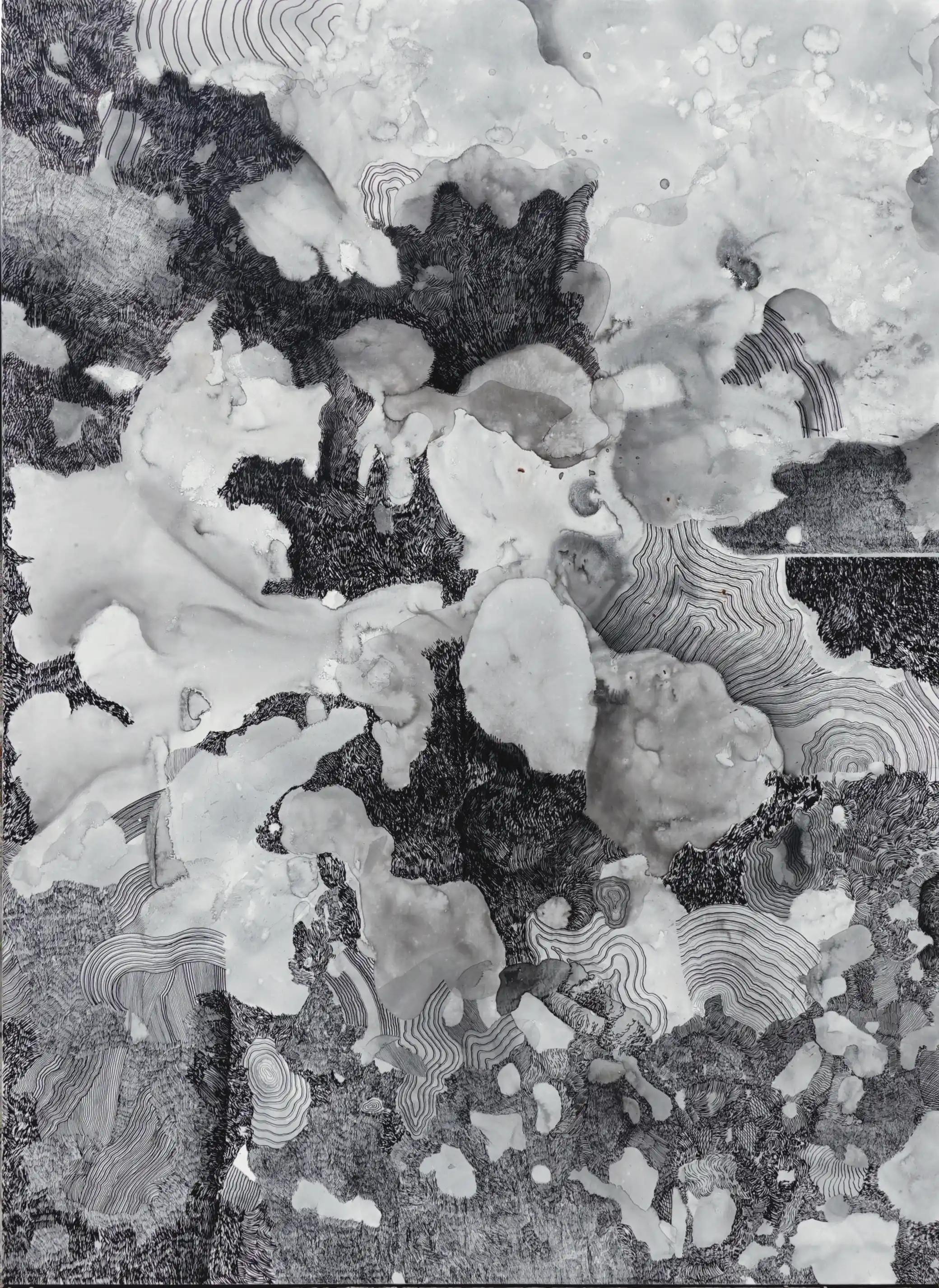
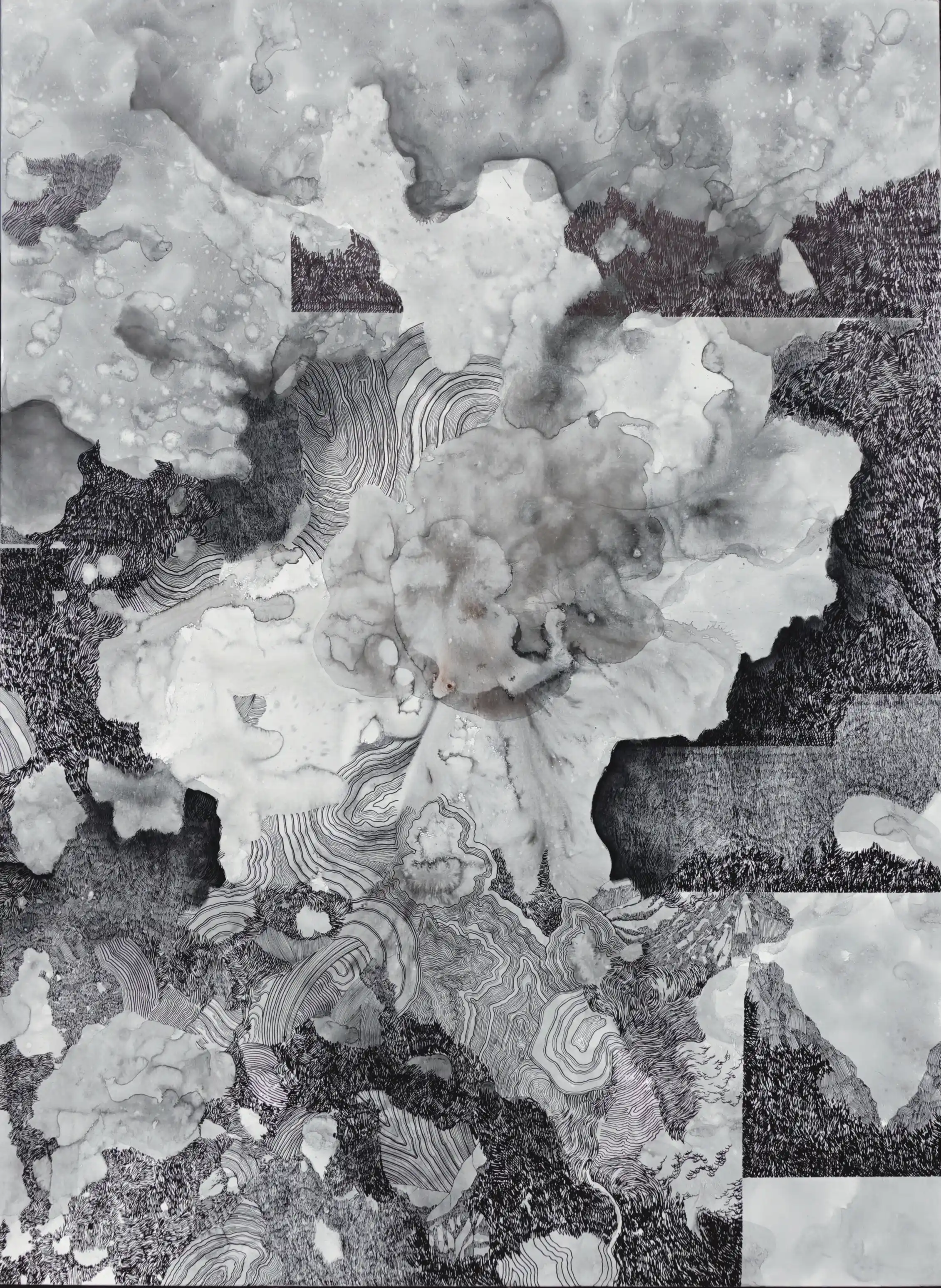
In Kemalezedine, the relationship with Balinese tradition originates from choice. He is not
Balinese, but more than a decade of life and practice in Bali has made Balinese traditional art an
important source of his artistic language. His interest in drawing, visual structure, rhythm, and
density led him to rerajahan and then to Kamasan. His position as an outsider gives him both
proximity and distance: close enough to study the tradition, yet sufficiently distant to dismantle
its visual system. Tradition is not continued as an intact system of meaning but transformed into
artistic material. Kemalezedine's case demonstrates that sensibility is not only inherited but can
also be acquired through learning and lived experience.
Dodit Artawan takes this spectrum further. He comes from and lives in Bali, but his visual
language—paint marker, line, color, figuration, and a graphic sensibility—is closer to popular
visual culture. In Welcome to My Neighborhood, Bali appears not through grand mythology, sacred
symbols, or tourism icons, but through small events, humor, oddities, people, and objects of
everyday life. The term pop-primordial can be used to read this encounter: “pop” refers to
contemporary visual language, while “primordial” refers to an elemental closeness to the environment
in which his sensibility was formed. In Dodit's work, the encounter between tradition and modernity
no longer feels like a boundary; it has become a habitat.
These five artists still allow their relationship with tradition to be traced through visual
language, skills, or the environments in which they live. In the following five artists, the
relationship becomes increasingly intangible and moves toward history, knowledge, materiality, and
the genealogy of sensibility.
In Yuli Prayitno, the past embodies as fragments. Past Future Tense uses fragments of Chinese
ceramics together with various contemporary materials. In the logic of antique objects, a crack or
chip diminishes value; Yuli instead sees each fragment as a possibility for gaining knowledge about
the past. He imagines himself as an archaeologist who does not excavate the earth but searches
behind the “concrete wall” of the homogenization of global society, in relation to generations of
Chinese-Indonesians who are increasingly distant from their previous cultural identity. The
fragments are not restored into whole objects. The past is instead read through its brokenness—as a
possibility for understanding what has happened while continuing to move forward.
Gusbarlian brings the question of post-tradition into the epistemological realm. Bottles containing
various objects and vintage-style photographs of children made with AI are used to question the
shifting authority of knowledge. If, in traditional societies, knowledge derives its legitimacy from
elders and customary rules, modernity places science and scientists as new authorities; today, the
internet, algorithms, and AI increasingly acquire a similar authority in everyday life. The form of
the “message in a bottle” brings together a mode of communication associated with the past with
artificial intelligence technology. In Deep Horizon, Gusbarlian considers how the space left by
tradition can be filled by markets, media, and algorithms. His work challenges trust in systems that
produce knowledge without existential experience. The threshold lies between lived experience and
calculated knowledge.
In Handiwirman Saputra, markers of tradition have almost entirely disappeared. Menara Susun Taut
Berpilin cannot be described as a representation of Minangkabau culture. Yet the rich Minangkabau
tradition of petatah-petitih and metaphorical language opens a possible reading of one genealogy of
his sensibility—not as a cause-and-effect relationship, but as one layer among art education, life
in Yogyakarta, artistic networks, and personal experience. Handiwirman's visual language has long
been constructed through strange encounters among objects, forms, materials, and associations.
Objects and forms in his work rarely operate literally; they are shifted, enlarged, brought
together, or stripped of their function and name, producing unexpected yet poetic relationships.
This tendency opens a possible reading in relation to a more distant genealogy of metaphorical
sensibility. In the context of post-tradition, something from cultural genealogy may survive not as
motif or iconography, but as a way of constructing poetic relationships.
Rizka Azizah Hayati demonstrates a different transformation. Menyentuh Dasar at first appears to be
an abstract composition of layers of color, brushstrokes, and rust stains. Yet at its center lies a
pair of human legs that almost dissolve into the materiality of the painting. The tension between
abstraction and figuration makes the body seem to emerge and sink at once; the threshold operates
directly at the level of appearance, between what can be recognized and what is disappearing. Rizka
grew up on the banks of the Martapura River in a Banjar environment shaped by stories, rituals, and
local knowledge of the river. In her earlier practice, she more directly worked with the mythology
of the river's guardian crocodile, family materials, and the experience of the Banjar house. As her
practice developed, these experiences increasingly ceased to appear as illustration. What remained
was a sensibility toward material and process. Rust, for example, relates not only to formal effect,
but also to wounds, fragility, history, and the past. Tradition and memory have moved from story
into material, from symbol into sensation, from representation toward bodily experience.
Meanwhile, Rudy Atjeh demonstrates how form and sound shift in meaning across history. Dum Meugeudum
Beudé Lam Lhee Jameun— “the boom of weapons across three eras”—takes the form of a cannon, but is
constructed from papier-mâché, pieces of paper, and brass elements. A form associated with violence
encounters fragile material and meticulous handwork. Rudy connects three layers of Acehnese memory:
the cannon as part of the history of resistance against foreign powers; beudé trieng, bamboo cannons
played toward the end of Ramadan as an expression of joy and spiritual victory; and the sound of
weapons during the conflict and DOM period, which again brought traumatic experience. What persists
is the boom, while its meaning shifts from resistance to celebration and then to trauma. Tradition
here is not something fixed, but something formed and transformed through the sedimentation of
history.
If all the works are viewed as a single constellation, a gradation becomes visible. In Kuncir,
tradition appears as mythology and visual language; in Agus, it has sedimented into a way of seeing;
in Budi, it becomes a skill and sensibility that persists as the medium changes; in Kemalezedine, it
becomes a chosen and transformed source; while in Dodit, the encounter between tradition and
modernity has become an everyday habitat.
In Yuli, the past appears as fragments to be reread; in Gusbarlian, as a question of the authority
of knowledge; in Handiwirman, perhaps as one genealogy of poetic sensibility; in Rizka, as memory
transformed into body and materiality; and in Rudy, as form and sound whose meanings shift across
history.
This spectrum demonstrates that the threshold is not a line separating tradition from modernity, but
a space of transformation. Something inherited may be preserved, changed, hybridized, chosen again,
forgotten, or settle so deeply that its origins are almost no longer visible.
What ultimately appears in the exhibition space is not tradition in its original state, but works
with their own languages, forms, materials, techniques, and personal character. Their value lies not
in successfully proving the existence of a particular inheritance, but in the artists' ability to
transform the sedimentation of experience into works possessing artistic intensity and sensuous
force. At this point, the threshold condition acquires form.
Returning to Jakarta: The Threshold as a Space of Possibility
After tracing the works in this exhibition, attention can return to Jakarta—the city where the
discussion of displacement and the threshold condition began. None of the artists presented is from
this city. They arrive carrying experiences, memories, sensibilities, and artistic journeys formed
in different places, and their works are temporarily brought together in Jakarta.
In this sense, the exhibition space becomes a kind of temporary space of sedimentation. Various
cultural experiences exist side by side without having to merge into a single identity or style.
Some works still strongly reveal traces of tradition; others have transformed them into skills,
material, metaphor, or ways of seeing, while still others almost no longer show those origins on
their surfaces.
On a much larger scale, Jakarta is shaped by a similar process. People arrive from different places,
settle, build families, and raise subsequent generations. Some original experiences persist, some
fade, mix, or reappear in new configurations. The city becomes a space of sedimentation that is
never complete.
Therefore, the question of post-tradition is not primarily about determining what remains
traditional and what has become modern. We never return entirely to tradition, yet neither do we
enter modernity from an empty space. What is inherited may continue to operate—consciously or
unconsciously—alongside new experiences that shape contemporary life.
Art does not offer a resolution to this condition. Yet artistic practice provides a space where
different layers of experience can be tested, diverted, brought together, and given new forms. The
past does not have to be restored, and modernity does not have to be accepted as an ultimate
destination. Both can become materials for possibilities that have not yet fully taken shape.
Thus, the remaining question is not whether we still possess tradition, but: what might emerge when
something inherited becomes distant, moves, encounters other experiences, and is given the
possibility to change? In this sense, the threshold does not merely mark rupture. The threshold can
also become a space of possibility.
Asmudjo J. Irianto
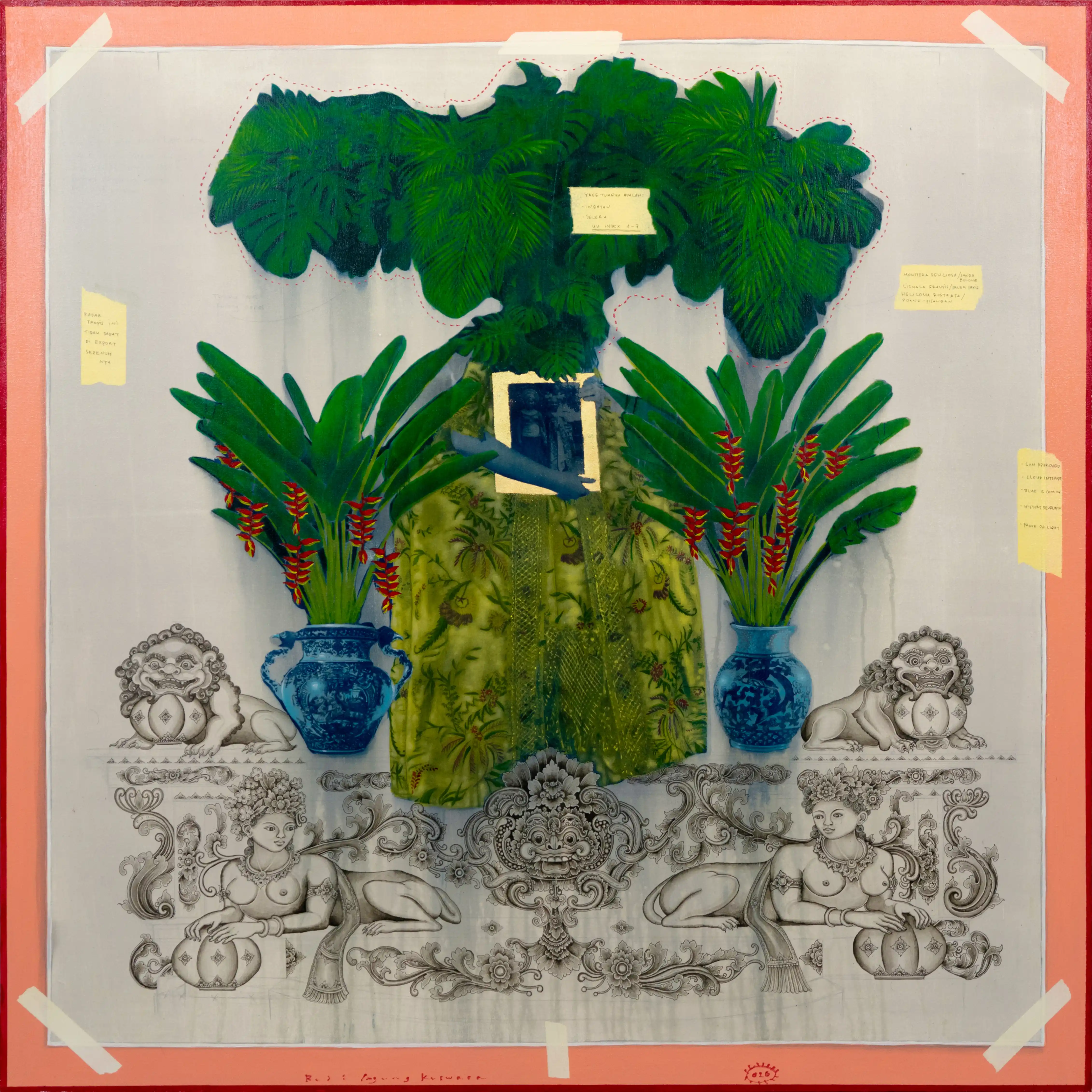
Budi Agung Kuswara
Altar of Living Memories, 2026
cyanotype, acrylic, ink, gold leaf 22K on canvas
110 x 110 cm
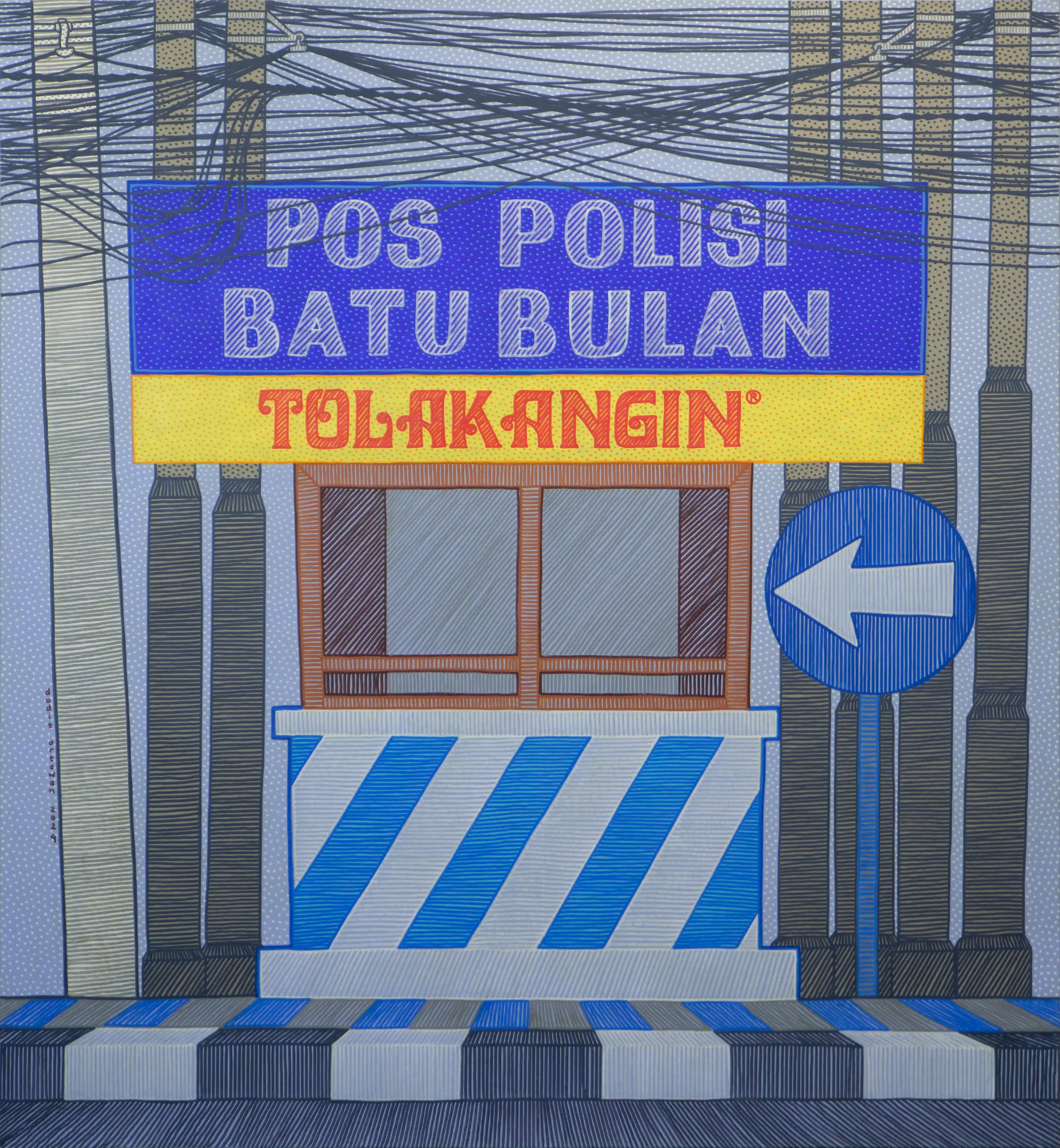
Dodit Artawan
Welcome to My Neighborhood No 2, 2024
paint marker and acrylic on canvas
130 x 120 cm
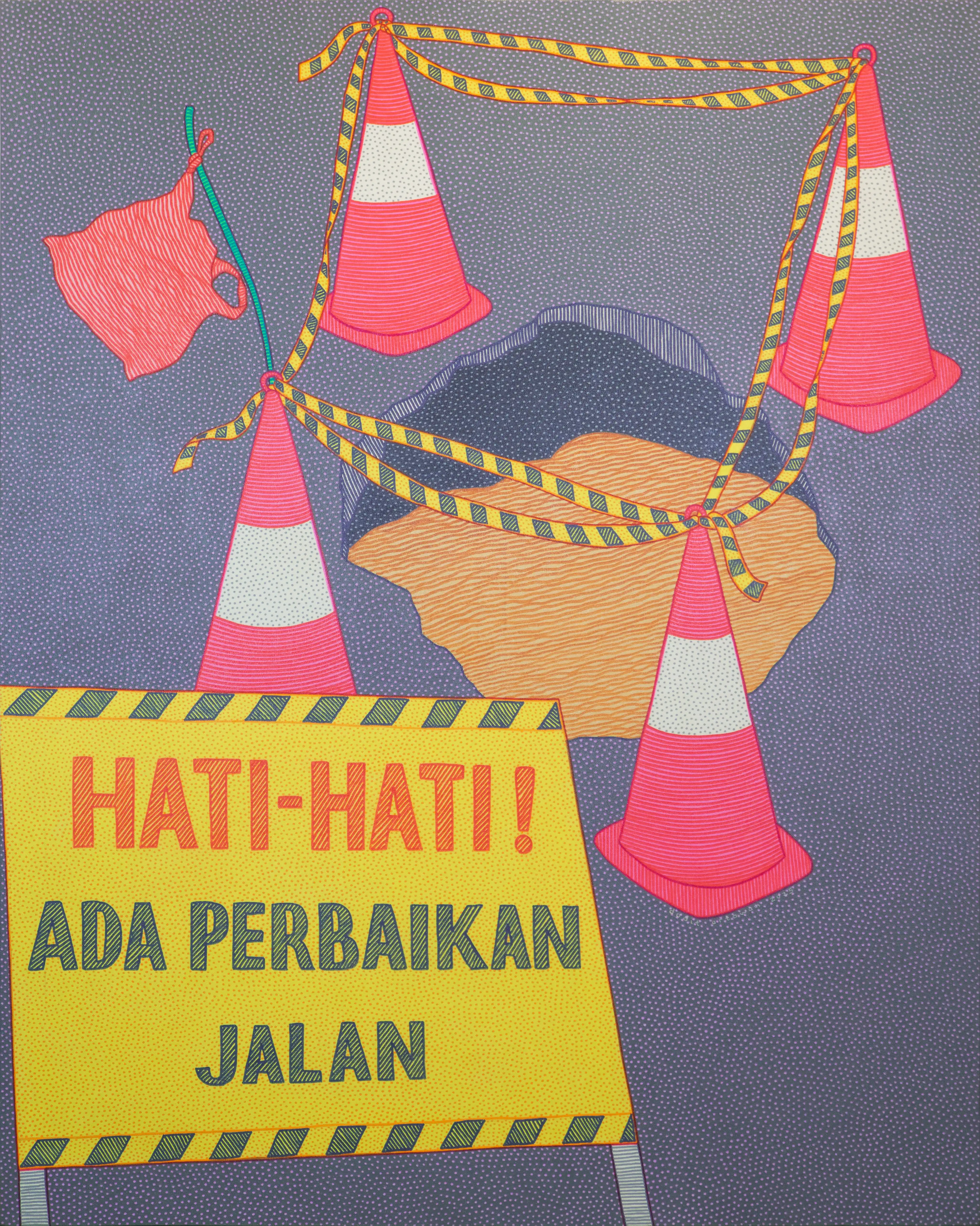
Dodit Artawan
Welcome to My Neighborhood No 6, 2025
paint marker and acrylic on canvas
150 x 120 cm
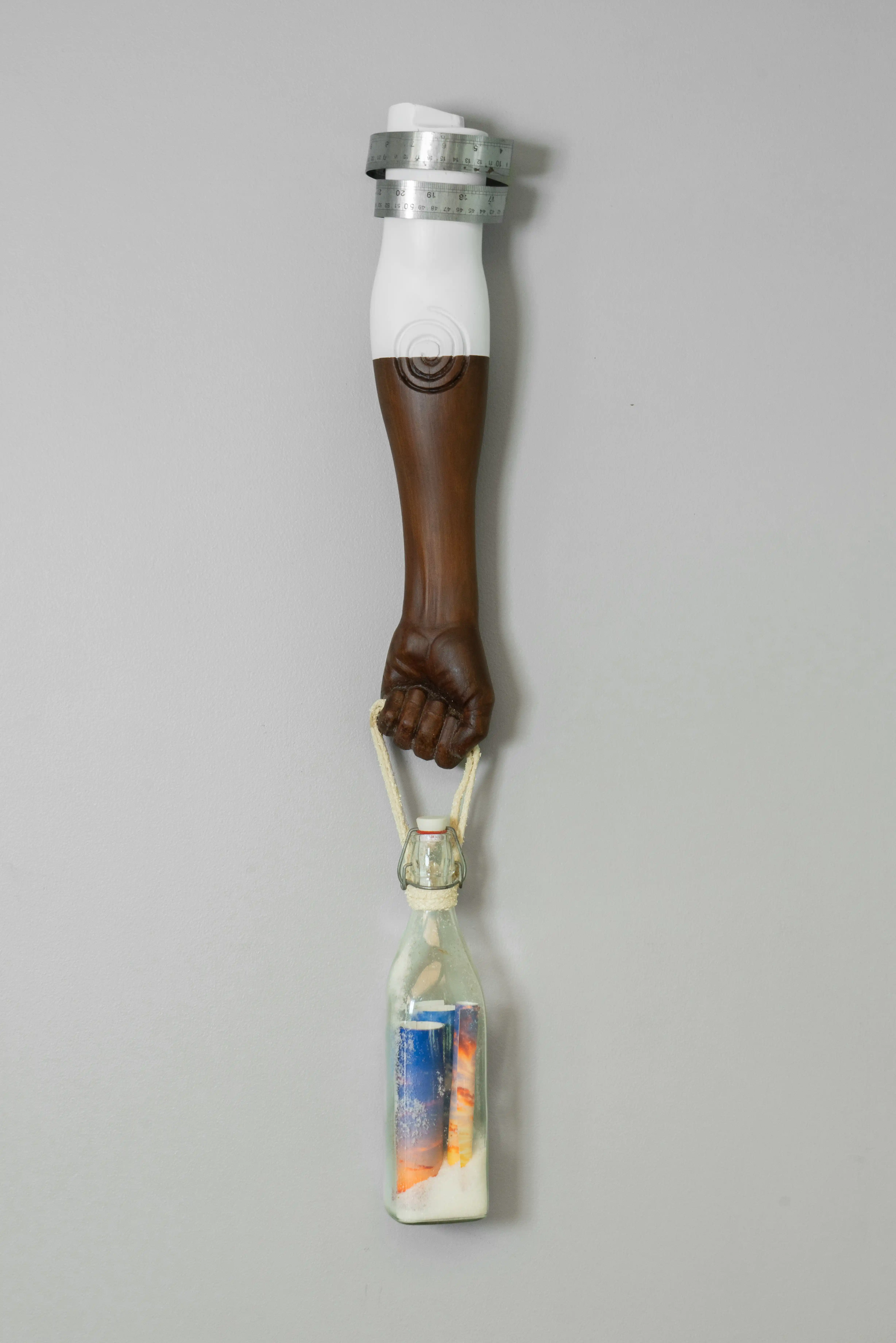
Gusbarlian
Muted Skies & Salt, 2026
wood, printed photo and salt in glass bottle, steel ruler and rope
88 x 12 x 11 cm
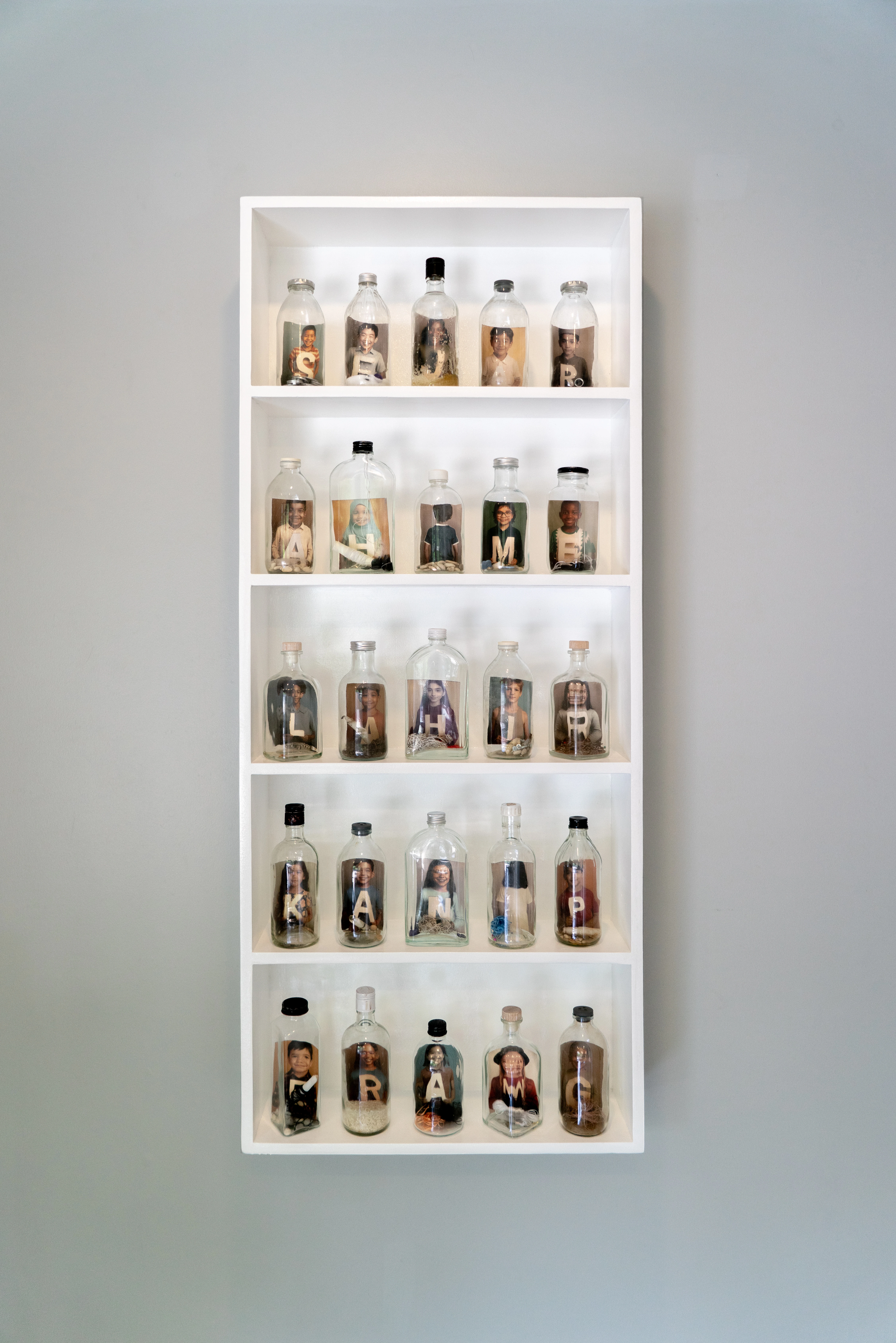
Gusbarlian
Spesimen #1 Sejarah Melahirkan Perang, 2026
wooden shelf, printed photo, pebble, salt, sugar, button, safety pin, needle, thread and
various objecy in glass bottle
146 x 59,5 x 16,5 cm
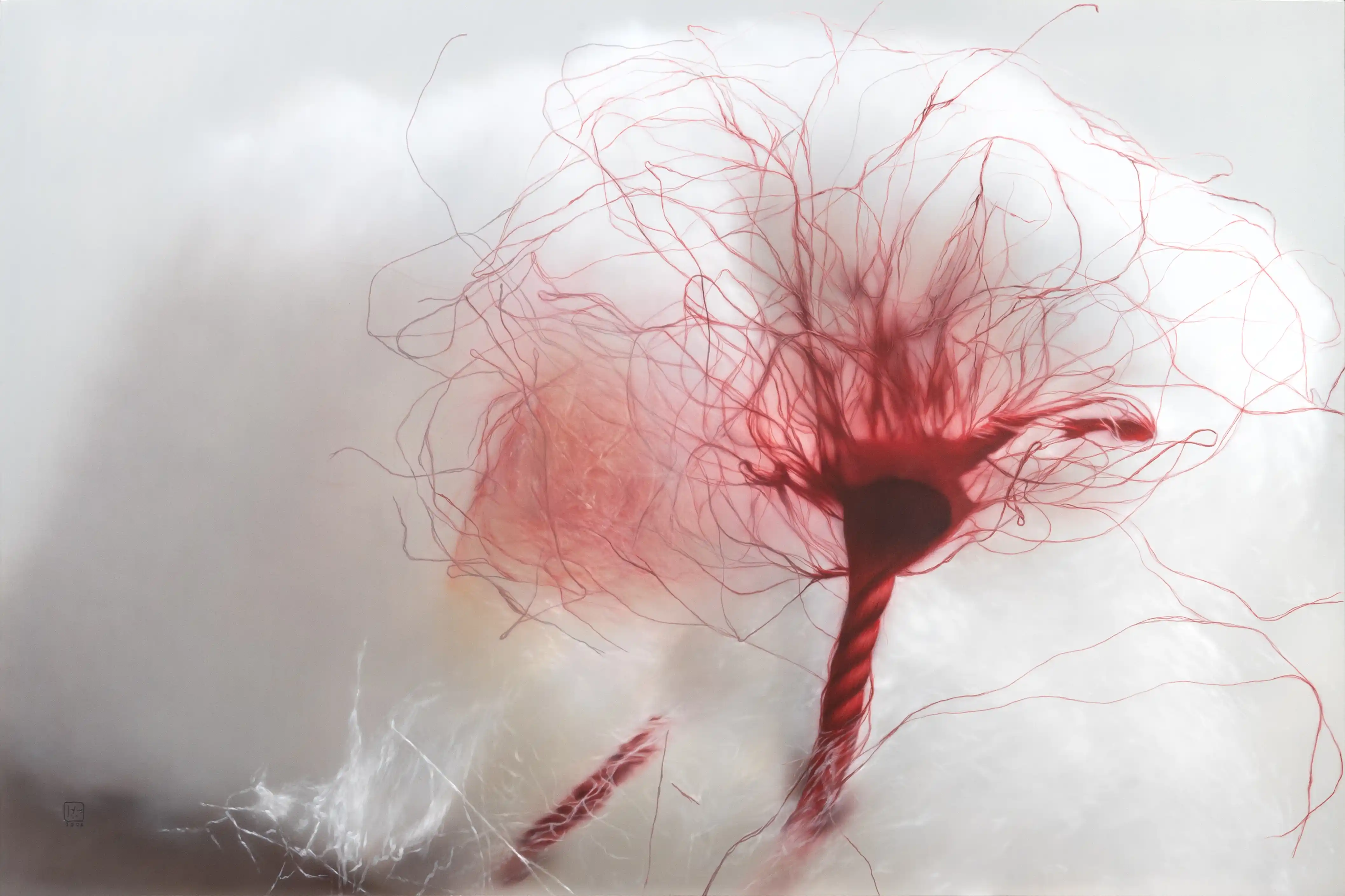
Handiwirman Saputra
Taut Berpilin #2, 2026
Acrylic on canvas
200x300cm
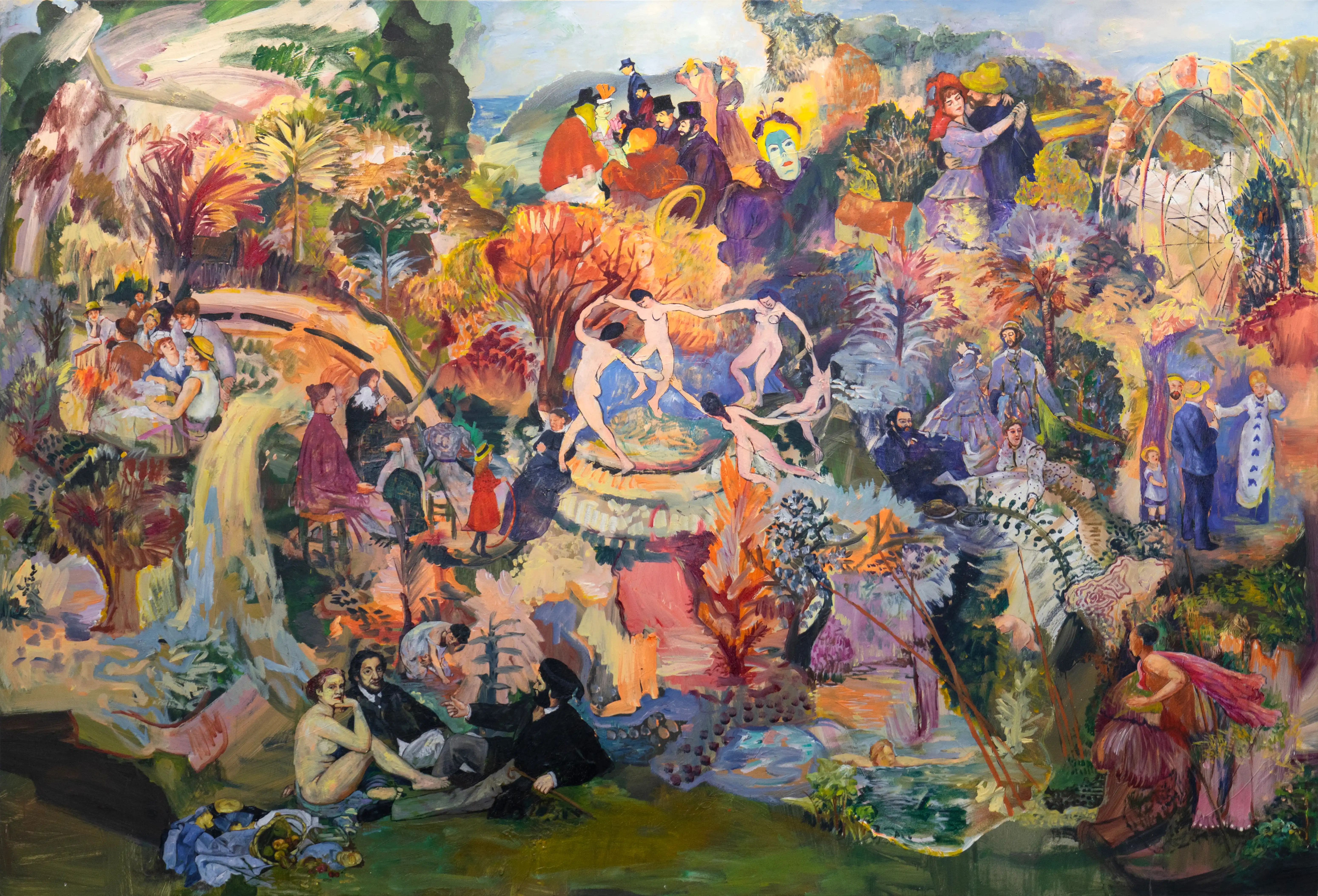
I M Agus Saputra
An Atlas of Joy, 2026
acrylic on canvas
170 x 250 cm
_2026_ink on canvas_180 x 390 cm (triptych).webp)
Kemalezedine
Liminality (All Panel), 2026
ink on canvas
180 x 390 cm (triptych)
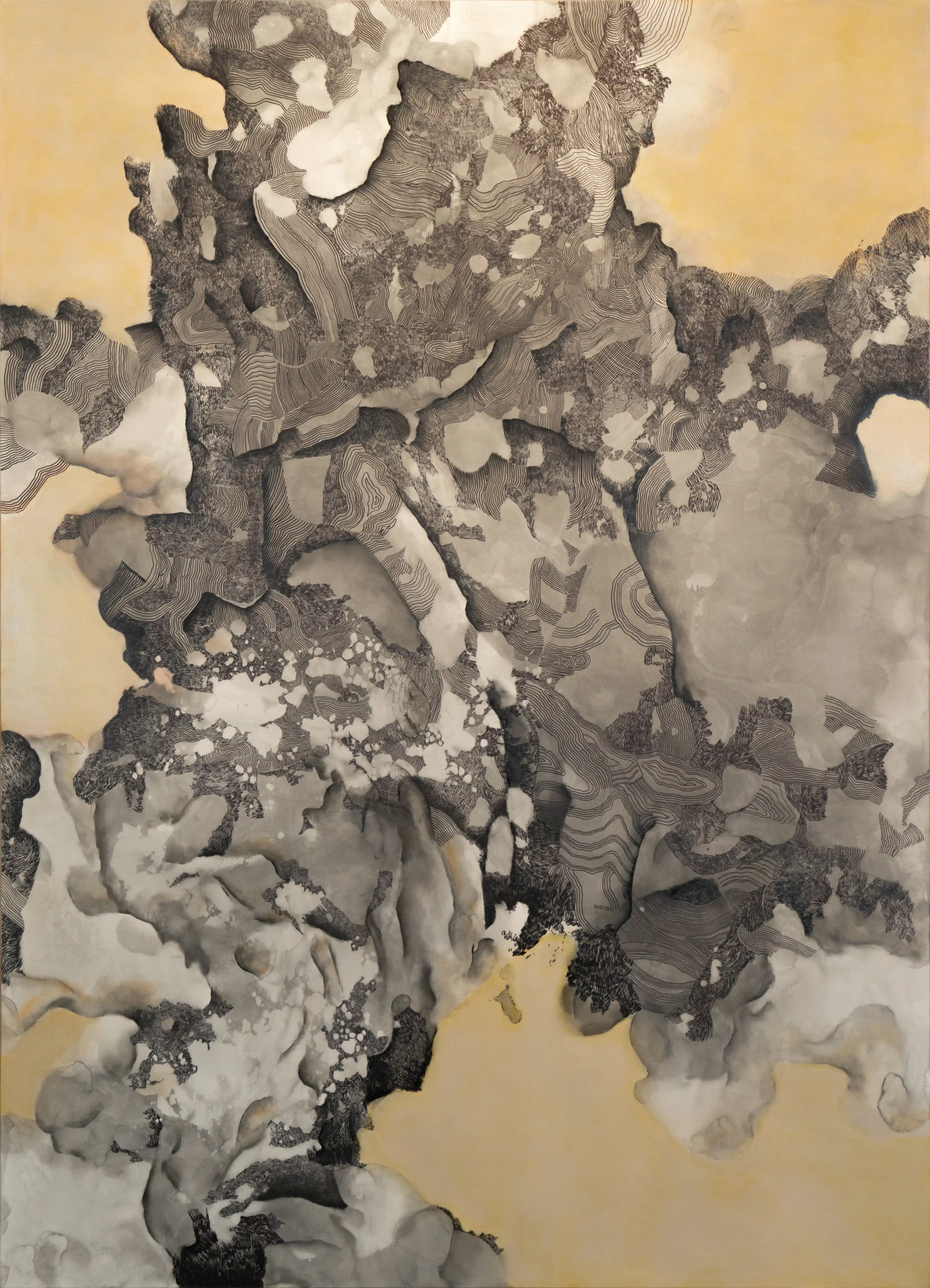
Kemalezedine
Liminality 1, 2026
ink and oil on canvas
180 x 130 cm
Kemalezedine
Liminality 2, 2026
ink on canvas
180 x 130 cm
Kemalezedine
Liminality 3, 2026
ink on canvas
180 x 130 cm
Kemalezedine
Liminality 4, 2026
ink on canvas
180 x 130 cm
Kuncir Sathya Viku
No Man s Land, 2026
acrylic and ink on mulberry paper mounted on canvas and teak wood
various dimension
Kuncir Sathya Viku
No Man s Land, 2026
acrylic and ink on mulberry paper mounted on canvas and teak wood
various dimension
Kuncir Sathya Viku
No Man s Land, 2026
acrylic and ink on mulberry paper mounted on canvas and teak wood
various dimension
Kuncir Sathya Viku
No Man s Land, 2026
acrylic and ink on mulberry paper mounted on canvas and teak wood
various dimension
Kuncir Sathya Viku
No Man s Land, 2026
acrylic and ink on mulberry paper mounted on canvas and teak wood
various dimension
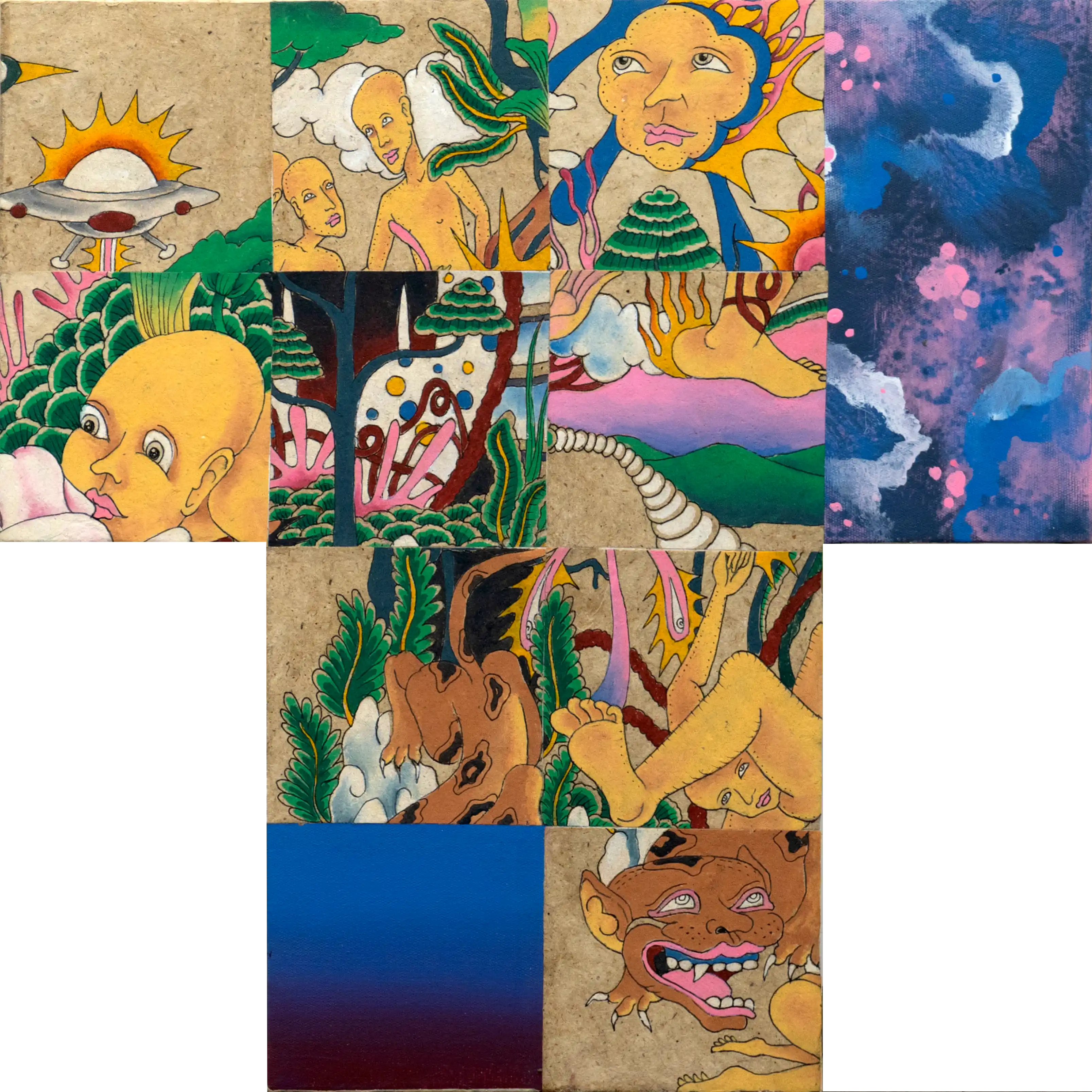
Kuncir Sathya Viku
No Man s Land, 2026
acrylic and ink on mulberry paper mounted on canvas and teak wood
various dimension
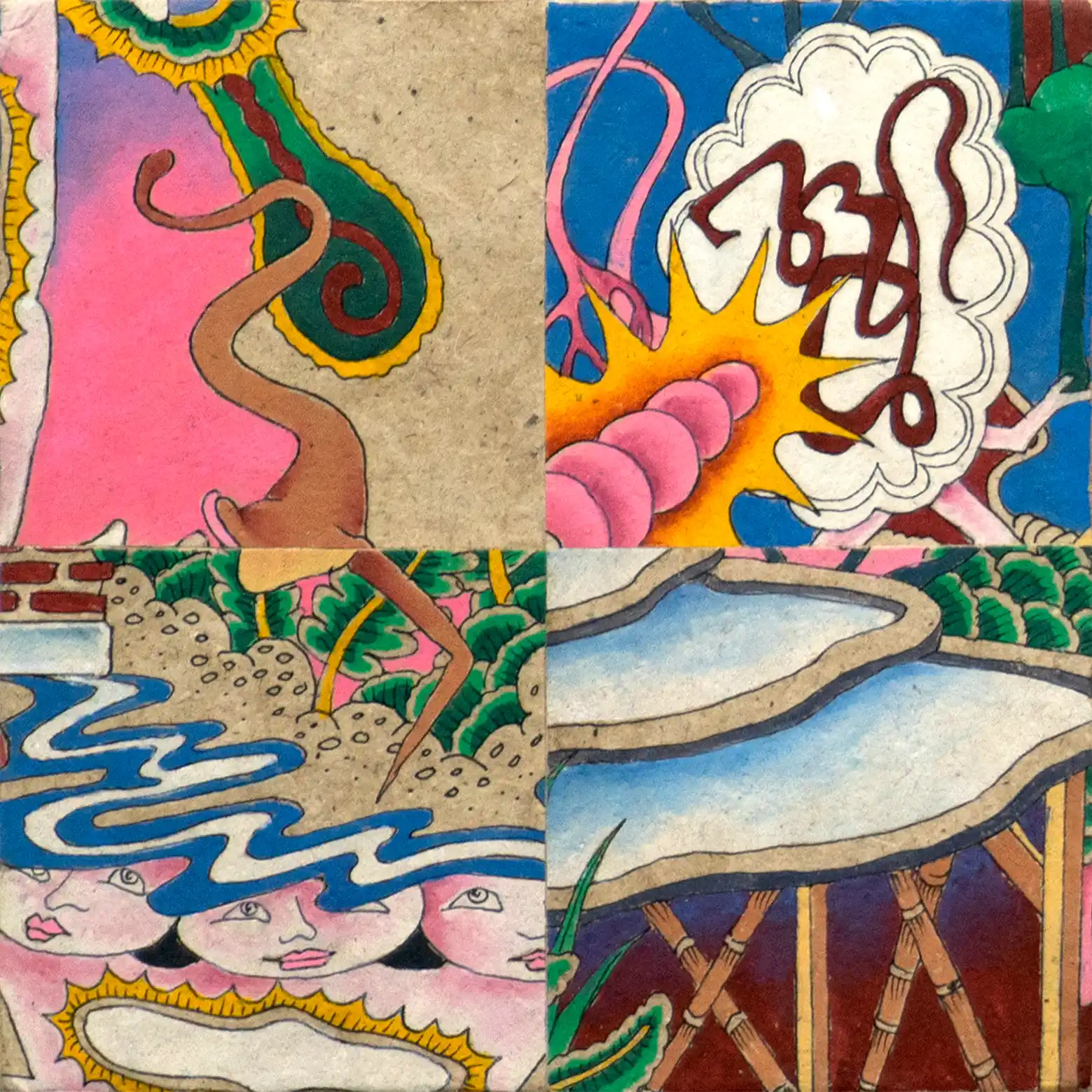
Kuncir Sathya Viku
No Man s Land, 2026
acrylic and ink on mulberry paper mounted on canvas and teak wood
various dimension
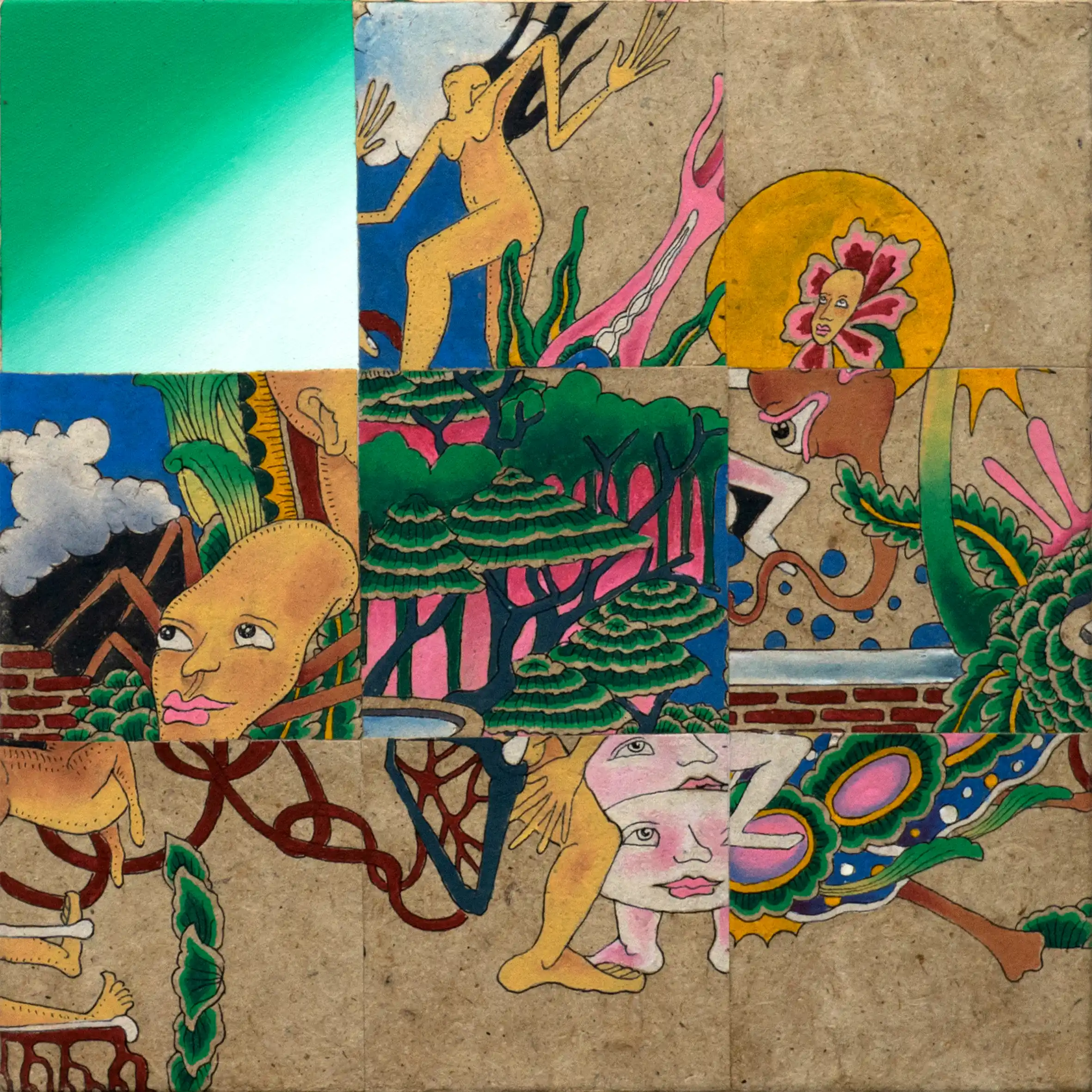
Kuncir Sathya Viku
No Man s Land, 2026
acrylic and ink on mulberry paper mounted on canvas and teak wood
various dimension
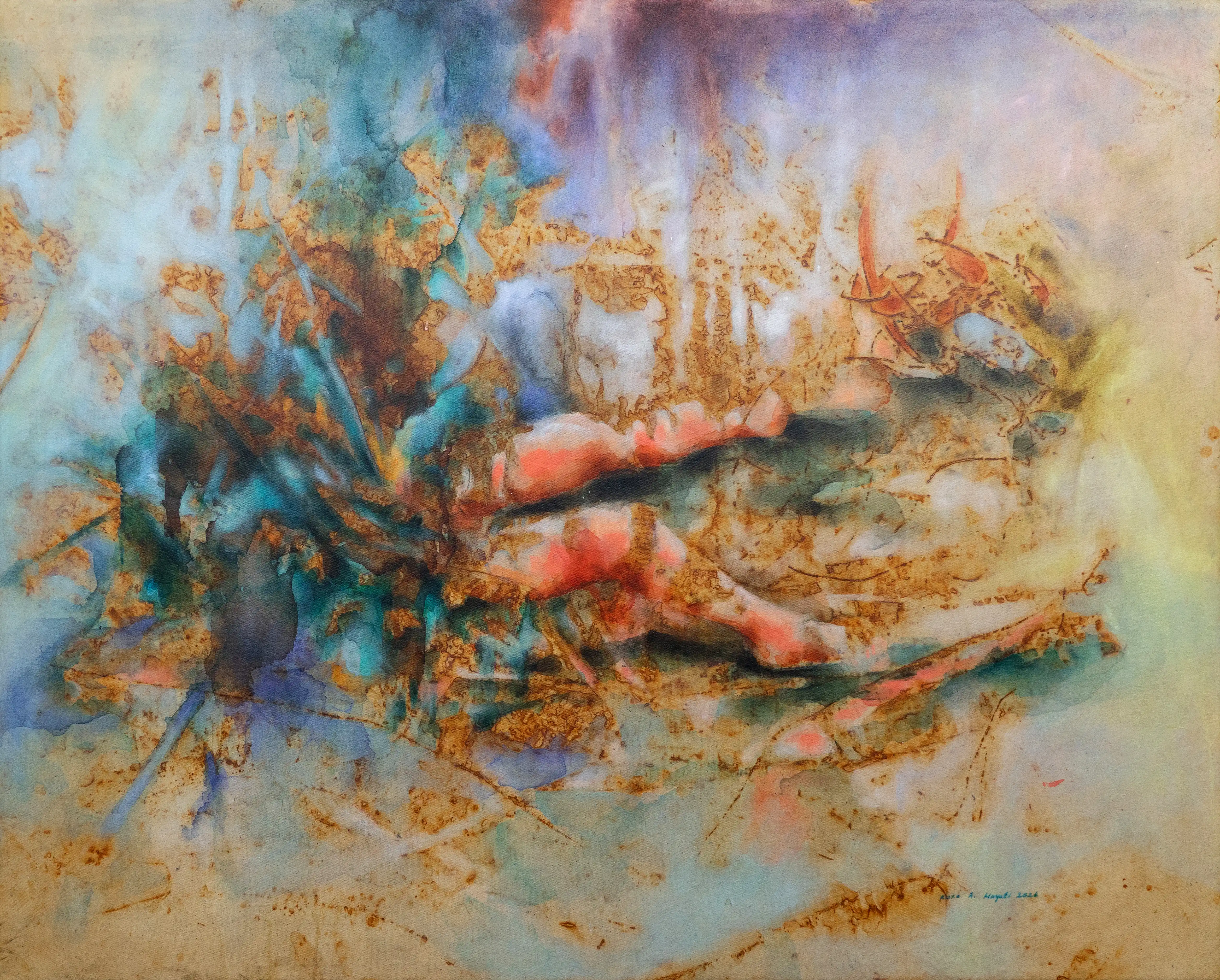
Rizka Azizah Hayati
Menyentuh Dasar, 2026
iron rust dye, waterproof elastomeric paint, transparent gesso and acrylic on canvas
118 x 147 cm
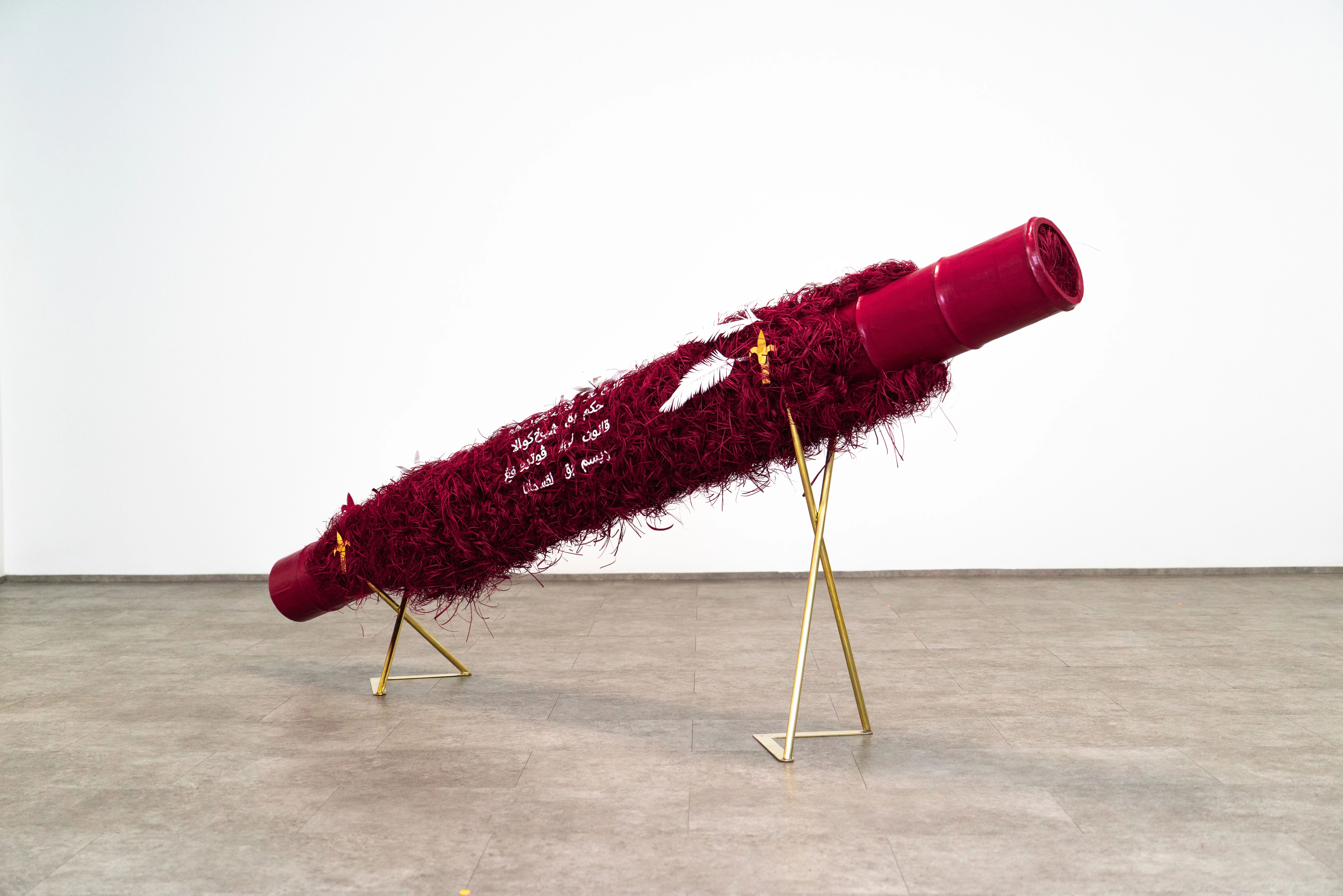
Rudy Atjeh Dharmawan
Dum Meugeudum Beude Lam Lhee Jameun, 2026
paper mache, handcutting on paper, samson paper 80 gsm, canson paper 300 gsm, linmaster
paper 115 gsm, coated brass plates and pipes
99 x 205 x 11 cm
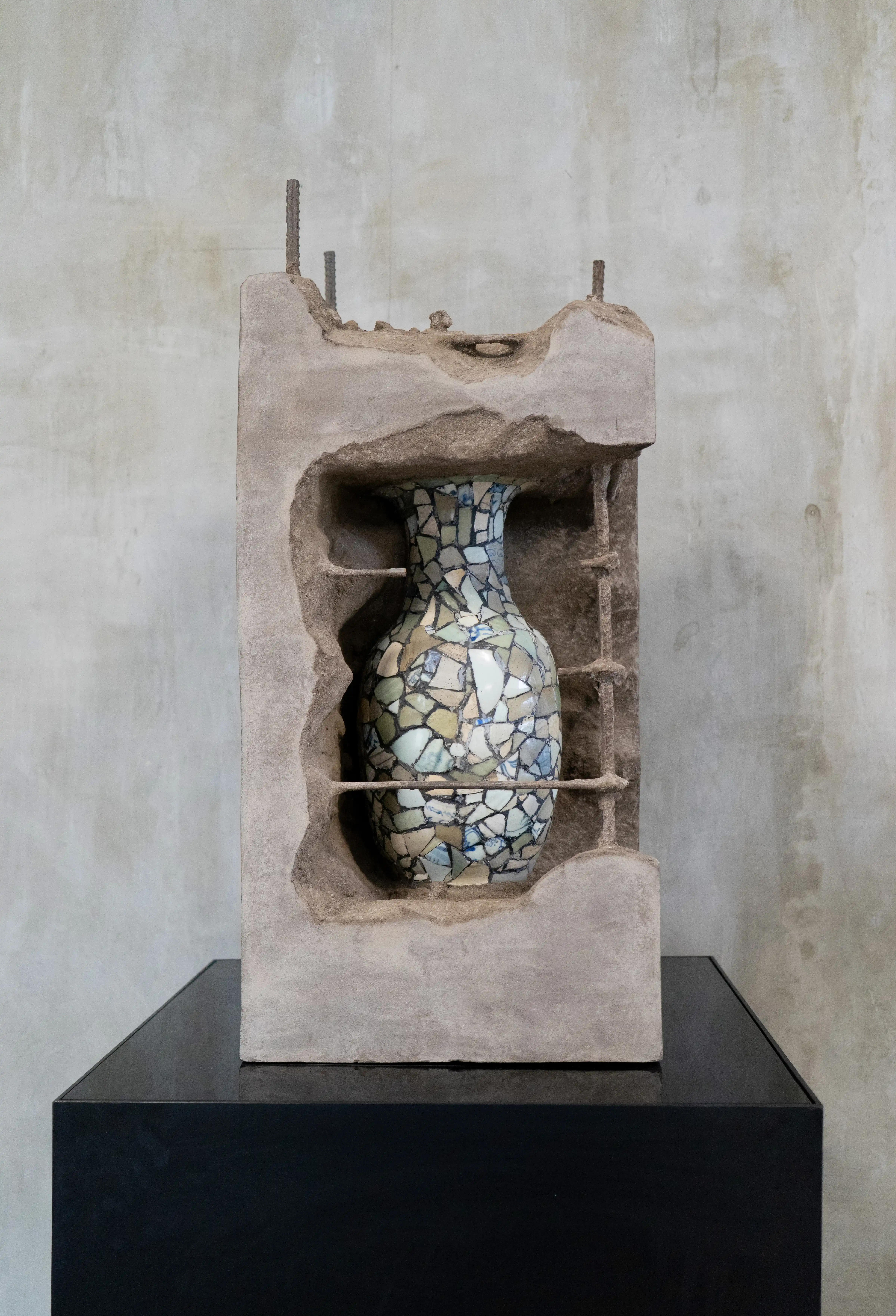
Yuli Prayitno
Past Future Tense, 2026
chinese ceramic fragment, epoxy adhesives, polyvinyl acetate, hydrophobic, sand, cast
iron
86,5 x 39 x 41 cm